
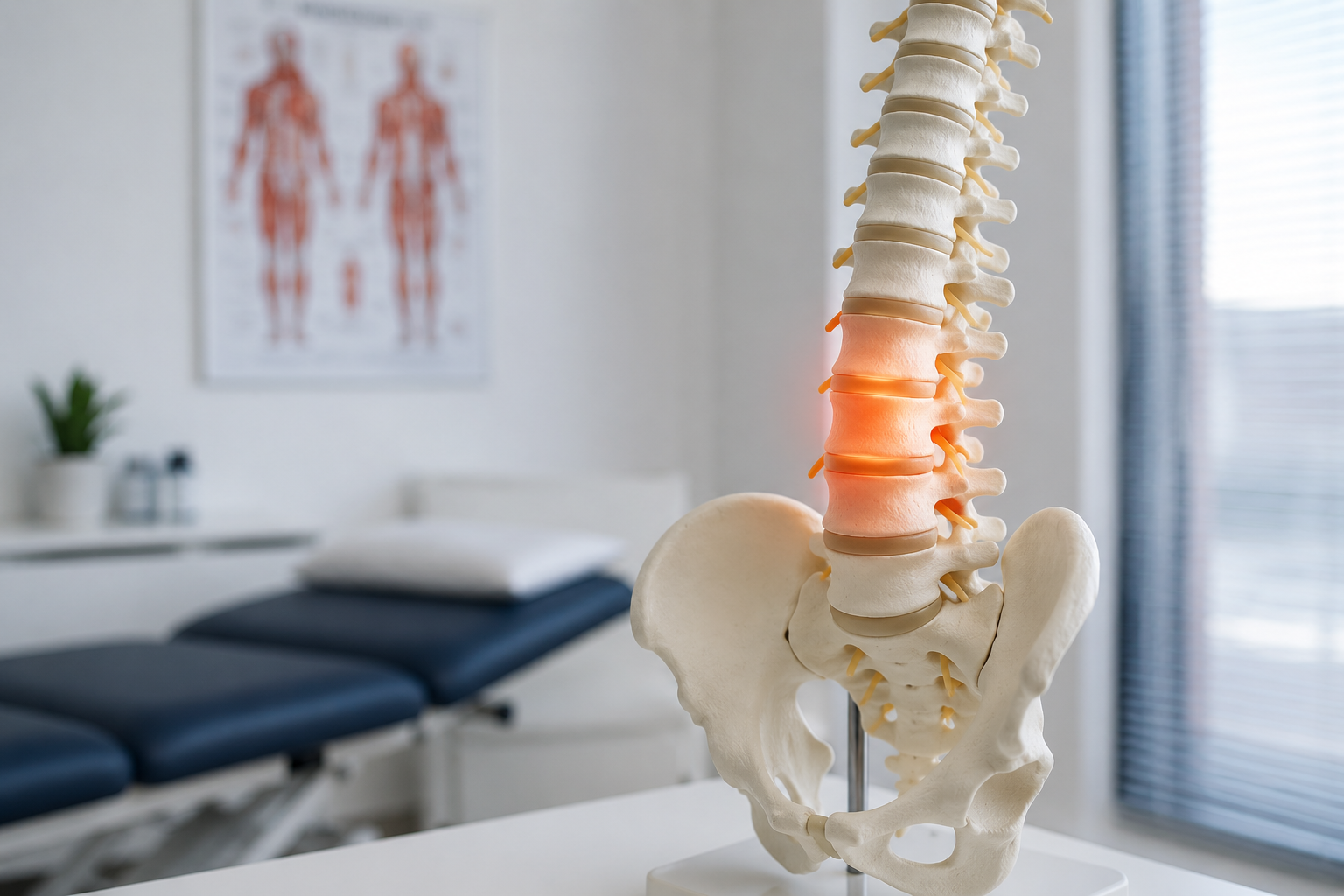
Back pain is very common. In many cases, it comes from muscles, joints, posture, lifting, stress, sport, or daily habits. But sometimes, long-lasting back pain can be linked to inflammation in the body.
A recent clinical masterclass by Carol McCrum and Hannah Chambers, published in Musculoskeletal Science and Practice, highlights the importance of screening people with persistent back, joint, and tendon problems for a group of inflammatory conditions called spondyloarthritis. The authors explain that these conditions are often under-recognised in musculoskeletal practice, which can delay diagnosis and affect quality of life.
At Osteopathy Syros, we believe that good care starts with asking the right questions. Our role is not only to treat pain, but also to recognise when symptoms may need medical investigation or referral.
What is spondyloarthritis?
Spondyloarthritis is a group of inflammatory conditions that can affect the spine, pelvis, joints, tendons, and sometimes other parts of the body.
It may include conditions such as:
- Axial spondyloarthritis, including ankylosing spondylitis
- Psoriatic arthritis
- Inflammatory bowel disease-related arthritis
- Reactive arthritis after certain infections
- Arthritis linked with uveitis, an inflammatory eye condition
McCrum and Chambers explain that spondyloarthritis can show up as back pain, joint pain and swelling, or tendon problems. This means it can easily be mistaken for a mechanical problem, especially in the early stages.
Why early recognition matters
One important message from the research is that diagnosis can be delayed for many years. The paper reports that axial spondyloarthritis takes an average of 8.5 years to diagnose, while peripheral spondyloarthritis may take 5–10 years from first symptoms to diagnosis.
This matters because long delays may lead to more pain, reduced movement, complications, and a bigger impact on daily life.
Early recognition does not mean assuming every back pain problem is inflammatory. It means knowing when to ask more detailed questions and when to refer for further medical assessment.
Signs that back pain may be inflammatory
Back pain linked with spondyloarthritis often has a different pattern from simple mechanical back pain.
You should consider assessment if your back pain:
- Has lasted longer than 3 months
- Started before the age of 45
- Came on gradually, without a clear injury
- Feels worse with rest
- Feels better with movement
- Wakes you in the second half of the night
- Causes morning stiffness lasting more than 30 minutes
- Is linked with buttock pain, especially pain that changes sides
- Improves clearly with anti-inflammatory medication
McCrum and Chambers highlight these features as important screening questions when assessing people with persistent back pain.
It is not only about the spine
Spondyloarthritis can also affect areas outside the back. This is why a full history is important.
Other possible signs include:
- Swollen or painful joints
- Painful tendons, especially Achilles tendon or heel pain
- Plantar fascia pain under the foot
- A swollen whole finger or toe, sometimes called a “sausage digit”
- Symptoms that move from one joint or tendon to another
- Symptoms that flare up and settle down
The paper explains that tendon insertion pain, called enthesitis, and whole finger or toe swelling, called dactylitis, are important clues in spondyloarthritis.
Important questions we may ask at Osteopathy Syros
During an osteopathic consultation, we may ask questions that seem unrelated to your back or joint pain. These questions help us understand whether inflammation could be involved.
We may ask about:
- Psoriasis, including skin or nail psoriasis
- Family history of psoriasis
- Inflammatory bowel disease, such as Crohn’s disease or ulcerative colitis
- Eye inflammation called uveitis
- Family history of inflammatory arthritis
- Recent stomach, bowel, or urinary infection
- Morning stiffness
- Night pain
- Swollen joints or tendon pain
McCrum and Chambers emphasise that psoriasis, inflammatory bowel disease, uveitis, and family history are important risk factors to screen for in people with persistent back, joint, or tendon symptoms.
Normal blood tests do not always rule it out
Many people think that if blood tests are normal, there cannot be inflammation. This is not always true.
The research explains that there is currently no single blood test that diagnoses axial or peripheral spondyloarthritis. Inflammatory markers such as CRP and ESR may be raised, but they can also be normal, even when symptoms are active. HLA-B27 can support suspicion in some cases, but being negative does not rule the condition out.
This is why symptoms, medical history, physical examination, and referral decisions must be considered together.
How Osteopathy Syros can help
At Osteopathy Syros, we take time to understand the full picture. This includes your pain, movement, lifestyle, medical history, previous injuries, sleep, morning stiffness, and any symptoms in other joints or tendons.
If your symptoms appear mechanical, osteopathic care may help improve movement, reduce strain, and support recovery.
If we suspect signs of inflammatory arthritis or spondyloarthritis, we will explain our concerns clearly and recommend that you speak with your GP or a rheumatology specialist. Osteopathy does not replace rheumatology care, but it can play an important role in screening, early recognition, and safe referral.
When should you seek further advice?
You should consider professional assessment if you have back pain lasting more than 3 months, especially if it started before the age of 45 and is worse at rest or during the night.
You should also seek advice if you have back pain together with:
- Psoriasis
- Crohn’s disease or ulcerative colitis
- Painful red eye or history of uveitis
- Swollen joints
- Heel or tendon pain that keeps returning
- A swollen whole finger or toe
- Strong morning stiffness
The earlier these signs are recognised, the sooner the right care pathway can begin.
Final message
Not all back pain is the same. Many cases are mechanical and respond well to hands-on care, exercise, and lifestyle changes. But some long-lasting pain may be part of a wider inflammatory condition.
The research by McCrum and Chambers reminds musculoskeletal clinicians that screening for spondyloarthritis should be part of good clinical practice. At Osteopathy Syros, we use this type of evidence-informed thinking to support safer care, better decision-making, and timely referral when needed.
Source: McCrum, C. & Chambers, H. (2026). Axial and peripheral Spondyloarthritis: Screening, suspicion and referral in musculoskeletal clinical practice. Musculoskeletal Science and Practice, 82, 103474.
Disclaimer:
This article is for educational purposes only and does not replace medical advice, diagnosis, or treatment.
About the Author:
Μάρτσιν Βοϊτάσεκ
Osteopathy Syros
Marcin provides osteopathic assessment and treatment for back pain, joint pain, muscle tension, sports injuries, and movement-related problems. His approach focuses on understanding the full picture, including symptoms, lifestyle, movement, and when needed, recognising signs that may require further medical referral.
Book an Appointment:
If you have persistent back pain, joint pain, stiffness, or tendon pain, you can book an assessment at Osteopathy Syros.
Απάντηση